
Customer satisfaction ratings
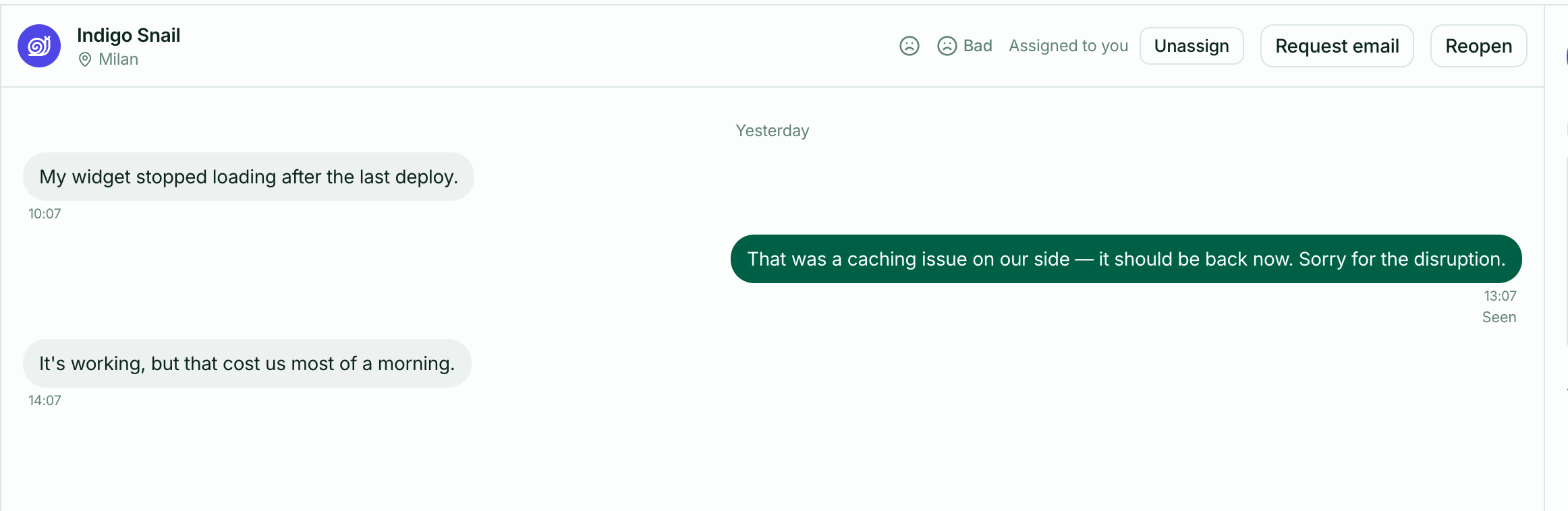
Three faces, shown on the conversation your customer rated.
By HeyThula · Updated
After a conversation is closed, your customer can rate it. The rating appears in the conversation header, as a face and a word.
Three options, not ten
Ratings are Bad, OK and Good. That's the whole scale.
Three options get answered. A ten-point scale invites deliberation, and deliberation is what stops people responding at all — so a coarse scale that lots of customers use tells you more than a precise one that few do.
Who can rate
Only the customer, and only on their own conversation. Your team can't set or change a rating, which is what makes it worth reading.
Rating is optional
Plenty of conversations are never rated. That isn't a signal in itself — people who are happy often just leave.
Read the ratings you do get, but don't treat unrated conversations as neutral, or compute percentages from a handful of responses.
What to do with a bad rating
A Bad rating on a conversation that looks resolved usually means the outcome was right and something else was wrong — how long it took, how many times they had to explain, or being handed between people.
The conversation is right there, so read it back. That's more useful than the score.
Ratings and the AI
A conversation the AI resolved can be rated like any other, which is the honest measure of whether your published articles are actually answering people — as opposed to merely matching them.
Persistent bad ratings on AI-resolved conversations are a sign your articles are technically relevant but not much help. That's a content problem worth fixing at the source.